
I Believed…
But What Happened?

The following includes an excerpt from Zee Prime Investor Letter
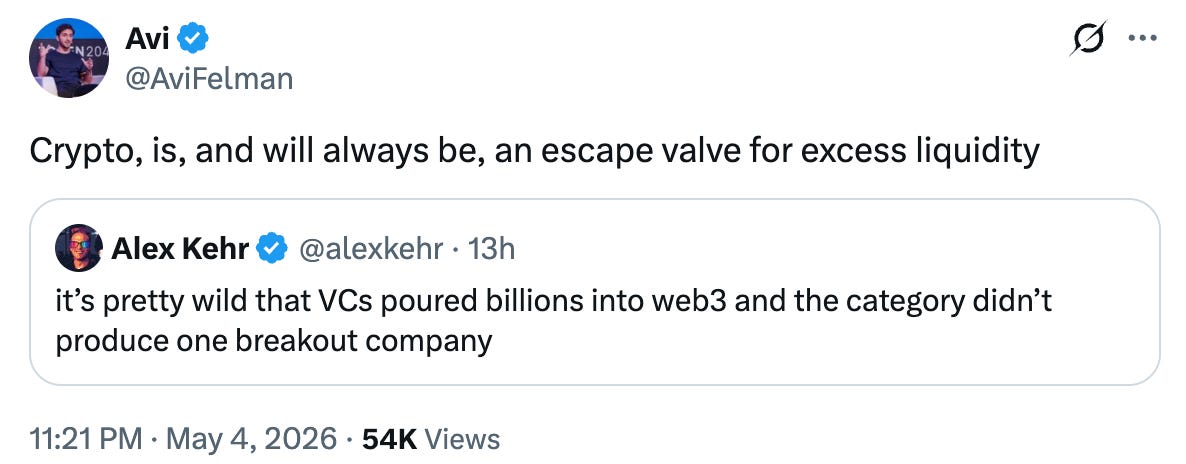
The perception is that crypto has been reduced merely to an “escape valve for excess liquidity”.
People are leaving the industry. The main reason is that financial rewards now lag significantly behind the expectations set by the past decade. The market did not deliver what they believed it ought to deliver.
This bear market genuinely marks the end of an era. We must ask: what exactly are we truly mourning?
In retrospect, 2021 stands confirmed as an illusion. If we were to plot a Gartner Hype Cycle curve, we would pinpoint 2021 as the peak of inflated expectations.
Today we’re touching peak clarity. This forces a return to first principles: rethinking tokens, solidifying the security of DeFi protocols, and discovering novel utility that makes crypto truly useful.
Ironically we could say “we have clarity of having no clarity” as the industry did not manage to adequately attribute failure and thus express the same cyclical/reflexive narrative hype cycles.
Since the early validation waves of 2017 or 2021, we adopted a “when you have a hammer, everything looks like a nail” mindset. Propelled by excess capital, crypto became a solution actively looking for a problem.
As history shows (and Manias and Mimesis describe): “While genius is rare, the demand of the credulous will always be met by a healthy supply of fraud.” Cryptoassets became perhaps the most reflexive asset class in history as a result.
The foundational principle of this financial mania was the early stage liquidity of tokens. The excess of this principle was the end of it.
In 2024, it was already visible that, in regard to exploration vs exploitation dichotomy, we’re milking the latter as an industry. The incentives were such that they pushed the industry to the edge of maximizing short term gains. Two years later, we reap the rewards.
I always believed that necessity is the mother of invention, but I was lately corrected that curiosity is the mother of invention and necessity is the mother of engineering. The recent wave of DeFi hacks clearly hints at the necessity. It is also an opportunity to re-engineer the first draft and keep iterating (e.g. on the token model side).
Curiosity, however, is not something that can be inspired. It must come from a place of genuine interest, not financial motivation. It can be aligned with financial motivation but not a precondition for tinkering at the frontier.
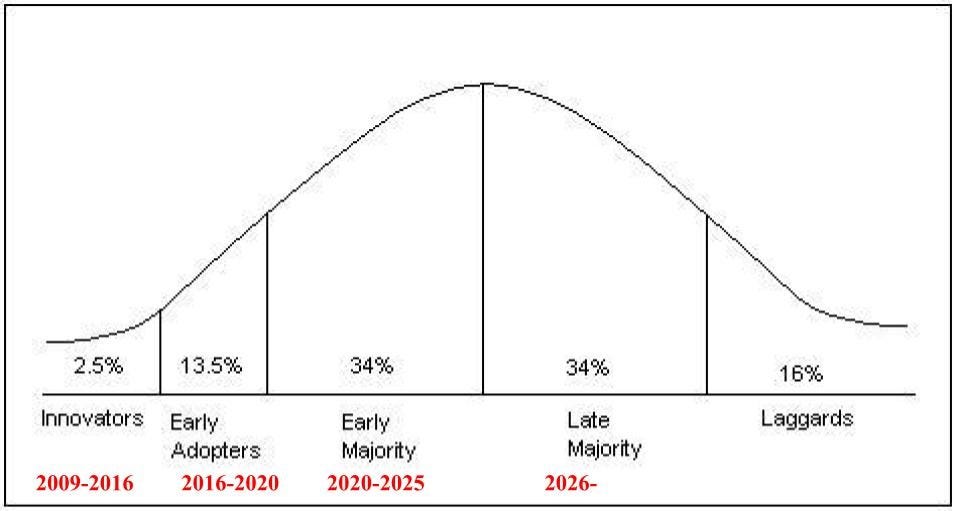
The disillusionment is also a culture shift. It comes with an important understanding that we’re not early. But for the right kind of builders and investors, this becomes a challenge, not an insurmountable obstacle.
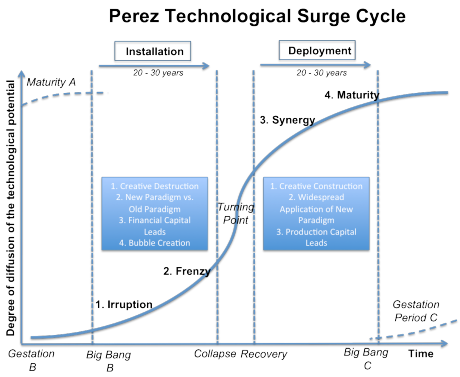
If you were to overlay the above Adoption Curve with the hype cycle, you would place the Trough of Disillusionment in the middle of the above. And to that same spot one could point out the Perezian “turning point”.
The core challenge remains the same: Crypto is undertaking the massive task of rebuilding the financial industry from scratch. That is not a light task. It will require various iterations, failures, and constant run-ins with reality.
We are, to some extent, back to the drawing board. However, this does not mean we have nothing to show for our efforts. Even if the industry is currently stalling, asymmetric opportunities still exist. And on the individual level, there is still the potential to alter the future.
The real risk now is throwing the baby out with the bathwater. Even the most fervent believers and preachers have abandoned the industry. We were once promised $100 trillions all we got was 200 DATs.
On Crypto VC
A lot has been said about “crypto VC being dead” or at least getting buried alive. I don’t believe that’s true. Venture capital as an asset class is going through a crisis, given the lack of DPI and the resulting struggle to raise capital.
In crypto specifically, the LPs that were used to “4-year cycle returns” are leaving disappointed, but I’d like to highlight that the 2016-2021 crypto returns were an anomaly, not the norm in venture capital.
In that period, crypto was sold as a revolution; a novel asset class and an immature market that was pumped full of cash, expanding beyond its ability to productively absorb the funding. The mania peaked in 2021. What followed has been a prolonged unwinding (in which short-term speculation reigned supreme) that brings us to today: an era of consolidation.
Manias and Mimesis, a discourse on the nature of technological bubbles, suggest that “the revolution can still happen—England still has its railroads…but the utopia envisioned by the most aggressive participants is never realized.”
What is more interesting is the ideological reversal. The original cypherpunk subculture that directly led to bitcoin is now courting Wall Street and financial regulators. Its fate actually hinges on policymakers.
This is not an irony but a feature of bubbles. Think about Google, the same company that publicly warned ads would corrupt search quality and went on to build an empire almost entirely on them. (Back to Mania and Mimesis:)
“This is one of history’s most extreme ideological reversals. To find anything comparable, you have to look back to figures like Martin Luther, a devout Catholic cleric who split the church in two, or Napoleon, who joined a movement opposed to monarchical overreach and wound up being a dictator. While this pattern is striking, it’s a pattern, not exactly an outlier: If you’re sufficiently committed to destroying some powerful institution, you eventually end up forming an even more powerful institution, and since that institution is subject to the same evolutionary pressures, it copies features of what it replaces.”
It is safe to say that the industry has abandoned the crypto utopia. The revolution did not happen. Instead, it got co-opted (or corrupted, depending on your ideology). Compromises have been made, as it was the only credible path out of the casino, the industry has descended into after 2021.
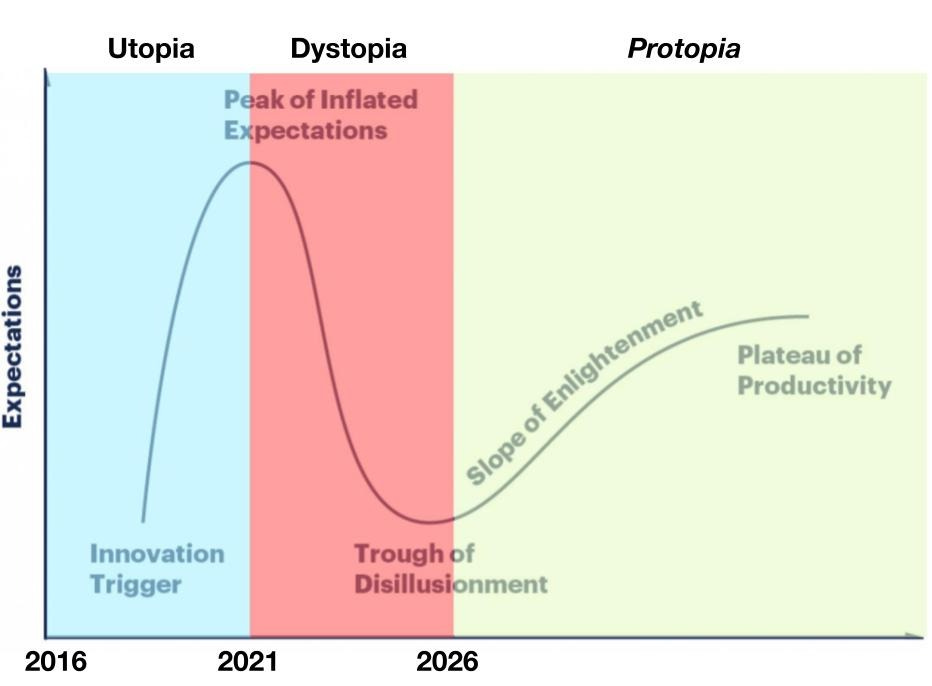
This transition can also be framed through the lens of Carlotta Perez, in which the Utopia part represents the “Installation Phase”, the dystopia is the “Turning Point” that leads to the enlightened “Deployment Phase”. The most successful investing styles differ in each of these phases.
Crypto is not a frontier anymore. Crypto is becoming a business. That’s not a bad or a good thing. It’s simply maturation. Today, there are broadly five categories of new crypto projects with various degrees of substance behind them:
Stablecoins
Prediction markets
Tokenization/RWA
Perpetuals
AI & Agents
To some extent, crypto is eating fintech (or fintech is eating crypto), which is far from the idea of a DeFi revolution. Crypto is looking for a killer use case (other than stablecoins) within the regulatory Overton window.
That being said, we believe that in years to come, generational businesses will be built in crypto, and we will still look for exceptional founders building great products.
Reconciliation
Perhaps I hold two contradicting beliefs. One that crypto is changing the nature of how value is stored and transferred, and the other that it is becoming a business that conforms to the existing financial norms.
The way I could reconcile the two is that perhaps crypto sneaks into our lives in non-obvious ways, as change is something invisible while it’s happening and clear only in retrospect. Perhaps the most profound shifts rarely arrive with a fanfare of $100 trillion promises. Instead, they embed themselves quietly into existing frameworks and minds of people.
Crypto is at its creative best as an underdog, not in the spotlight. Those who are genuinely curious will rethink and redesign. There’s a lot to build and not less to fight for.
I still believe.
Thanks to Lochie for helpful thoughts and believing.