

Room 1408 is not scary because you’re trapped in it. It’s scary because the room almost lets you leave. There’s a clock on the nightstand. It counts down from sixty minutes.
There’s a window, and for a moment it looks like an actual way out. Until you’re close enough to see it actually isn’t. There’s a fire, eventually, that burns the room down to nothing, and it feels like the end. Then you’re back at the door. Sixty minutes on the clock again.
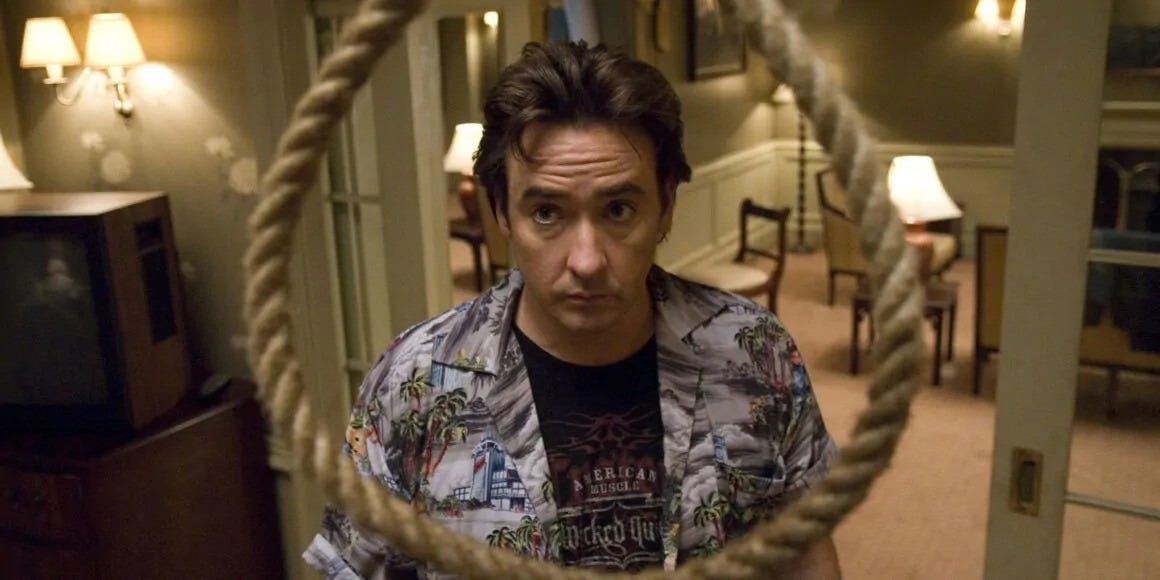
The audience remembers the room as a loop but it isn’t one. A loop repeats identically, and you’d notice after the second time. This resets with just enough variation that you keep believing. This time it’s different.
That’s the actual design. Not repetition but the sensation of progress that gets cancelled at the last second, over and over. We’ve been living in some version of that room for a while now.
Right now there might be a video telling you Russia’s economy is weeks from collapse. There was a similar video three years ago. There might be a Truth Social post telling you a peace deal with Iran is imminent. There was one a few days ago.
There might be one next week, next month, next year. Same clock. Same fire that isn’t a fire.
It’s Not About Which Way It Ends
Search for Iran and you’ll find a peace deal happening any day now. Search again and you’ll find Iran’s total destruction happening any day now. Both filed under “soon”. Both are delivered with the same certainty, by different people, sometimes the same week.
You can follow the same pattern in “tech” narratives. AI is a bubble about to pop any day now. AGI is about to arrive any day now. It seems that both doom and utopia are running on identical scripts.
Elon Musk said a version of both on The Economist’s stage this July. Money loses its meaning once AI and robots outproduce anything we could spend it on. We should give it a decade. AGI outthinks the species not long after. He’s done this before. Full self-driving next year, every year, for a decade. This time the number is bigger and further out, which only makes it harder to check.
It was never about which outcome you’re rooting for. Whatever you want to be true, someone is already telling you it’s imminent, in the exact same rhythm as the person telling the opposite person their opposite thing is imminent. The machine doesn’t have an opinion about which way the door opens.
It just needs you checking whether it’s opening.
The Business Model Of Never Arriving
What makes it durable is that nobody built this on purpose. It’s an emergent phenomenon. If you run a channel about Russia’s imminent collapse, an actual collapse is not good news for you. It’s the end of the format.
There’s nothing left to cover once the thing happens, only what comes after, and what comes after is rarely as bookable as what’s about to. So the videos don’t need Russia to collapse. They need it to be always about to, forever close enough to justify the next upload.
This isn’t cynicism about any one person. It’s just what the incentive rewards. A resolved story stops generating views. An unresolved one generates one every week indefinitely as long as it stays exactly one week from resolving.
Systems Don’t Have Authors
But this doesn’t run on supply alone. We want the ending as much as anyone’s selling it. States, markets, and technologies don’t run on plot. They run on millions of uncoordinated incentives with no author and no third act.
And we process time as a story. That’s the only shape our attention knows how to hold, beginning, middle, end. So we take whatever ambiguous data point is closest to hand: a bad inflation print, a leaked memo, a rumor of a ceasefire, and we cast it as the climax.
Supply doesn’t have to invent this appetite. It just has to keep feeding it. Demand doesn’t have to be gullible (just credulous enough). It just wants an ending badly enough to accept a fake one on schedule. And through Oscar Wilde we know there are two tragedies in life; “one is not getting what one wants, and the other is getting it”.
The Room’s Fake Clock
This is where 1408 stops being a metaphor and becomes a mechanism. The countdown clock is the Fed meeting, the peace deal, the model release date. A fixed point you can point to and say: by then, we’ll know.
The date arrives, something happens, and it’s never quite the thing, so a new date appears right behind it. The clock never stops counting. It just resets.
The window is the partial signal that looks like daylight. The leaked memo, the surprise data point, the ceasefire rumor. Close enough to feel like an opening. Never close enough to be one.
The fire is the event that feels final while it’s happening: an assassination, a crash or a launch. It burns the whole narrative down in real time, gets called historic by the end of the day, and by the following week you’re back at the door with the clock reset to sixty.
None of it is fake in the sense of being invented. The inflation print is real. The launch happened. The fire actually burns. What’s fake is the ending it was sold as.
Nobody’s Lying
That’s the uncomfortable part. There’s no single liar to point at. The channel isn’t lying, the collapse might genuinely be closer than last year. The audience isn’t stupid, wanting resolution isn’t a character flaw.
It’s a closed loop: supply needs an audience that wants an ending, demand needs a supply willing to keep promising one, and the actual event is the one thing neither side needs to ever show up.
None of this is an argument for the “nothing ever happens guy” either. Betting confidently that nothing changes isn't the exit either. It's not unfalsifiable, just rarely tested. Rarely tested feels a lot like being right. Both postures let you stop updating and start watching the clock instead.

Things do happen. Empires fall, currencies get replaced, wars stop. None of it arrives on the date anyone gave you, and none of it announces itself as the climax while it’s happening. The correction isn’t optimism or pessimism about the outcome, it’s refusing to let a countdown stand in for information at all.
A specific date feels like evidence. It’s closer to Wittgenstein’s ruler: measure the table with a ruler you don’t trust, and you learn about the ruler, not the table. You learn more about one’s incentives, not the system’s odds, and that’s true whichever way it points.
Someone Owns The Clock
Somewhere along the way, someone with actual power figured out the mechanism doesn’t have to be an accident of content economics. If uncertainty holds an audience, it also holds a negotiating table.
A deadline that keeps sliding isn’t a failure of the deal, it is the deal.
Every extension resets the clock, and every reset keeps the other side guessing, which is the actual product being sold. None of this is new because unpredictability as leverage is old statecraft. What’s new is the speed the room now resets at. (And an explicit price you pay for seemingly faster access.)
Markets don’t stay confused by it for long. Once enough people notice the deadline is the tool and not the outcome, the volatility it produces gets priced in advance, sold, hedged, packaged.
What started as manufactured suspense becomes a rent, collected by whoever can hold the risk, paid by whoever can’t. The room stops being a side effect of the attention economy and turns into an asset class. The medium was always the message and now the message has a strike price.
The discourse machine doesn’t care about the outcome. It’s designed to keep producing imminence. Room 1408 doesn’t need a monster and only needs you checking the clock.